

A Mommy Makeover may combine procedures involving different anatomical areas, such as the breasts, abdomen, waist, and flanks. Because of this, planning extends beyond choosing which aesthetic procedures to perform. The overall surgical burden, anesthesia, postoperative mobility, wound healing, thrombosis risk, recovery environment, and follow-up must also be considered.
Recovery also differs substantially between patients. A patient undergoing limited liposuction and breast surgery may have a different postoperative course from someone undergoing abdominoplasty with abdominal wall repair and additional breast procedures.
For this reason, Mommy Makeover should be approached as an individualized surgical and recovery plan, with safety considerations incorporated from the beginning rather than addressed only after the procedures have been selected.
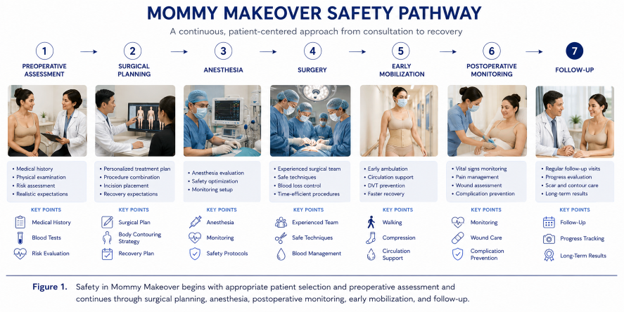
1. Safety Begins Before Surgery
The safety of a Mommy Makeover begins long before the patient enters the operating room.
A detailed medical assessment is particularly important when several procedures are being considered during the same operation.
Preoperative evaluation may include a review of:
- General medical history
- Previous operations
- Current medications and supplements
- Allergies
- Smoking and nicotine exposure
- Previous anesthesia-related problems
- History of abnormal bleeding or thrombosis
- Cardiovascular and respiratory conditions
- Body weight and recent weight changes
- Previous abdominal or breast surgery
- Future pregnancy plans
Appropriate laboratory testing and additional investigations may be requested according to the patient’s age, medical history, planned procedures, and anesthetic requirements.
The surgeon should also evaluate the anticipated extent and duration of surgery.
This is particularly relevant in Mommy Makeover because adding procedures does not simply increase the aesthetic scope of surgery; it may also increase operative time, tissue trauma, postoperative discomfort, mobility limitations, and recovery demands.
Therefore, the question should not be whether several procedures can technically be performed together, but whether combining them represents an appropriate plan for that particular patient.
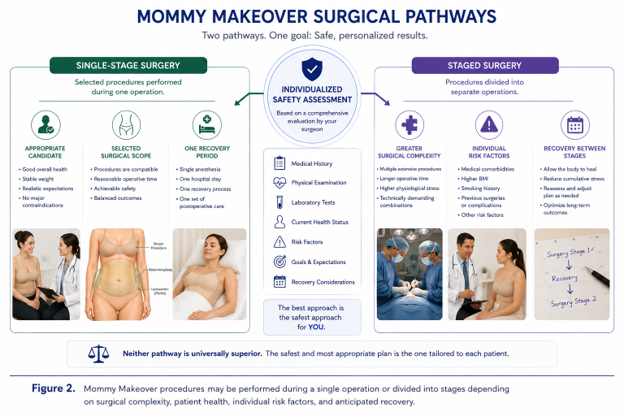
2. One Operation or Staged Surgery?
One of the potential advantages of combining procedures is that several concerns can be addressed during a single surgical and recovery period.
However, this does not mean that every desired procedure should automatically be combined.
The decision between a single-stage Mommy Makeover and staged surgery depends on several factors, including the extent of the planned procedures, anticipated operative time, patient health, individual risk factors, and expected recovery.
For example, a relatively healthy patient requiring a carefully selected combination of procedures may be considered differently from a patient requiring extensive surgery across several anatomical regions.
In selected circumstances, dividing treatment into separate stages may reduce the extent of each operation and allow recovery from one procedure before proceeding to the next.
A staged approach should not be viewed as an incomplete Mommy Makeover. In some patients, it may represent a more appropriate way to achieve the overall treatment objective.
3. Anesthesia and the Operating Environment
Mommy Makeover procedures involving abdominoplasty, breast surgery, or extensive body contouring are generally substantial operations and require appropriate anesthesia and perioperative monitoring.
The anesthesia plan should be determined according to the procedures being performed, expected duration of surgery, patient health, and other relevant clinical factors.
During surgery, physiological parameters such as oxygenation, circulation, blood pressure, heart rate, temperature, and other relevant indicators are monitored by the anesthesia team.
The operating environment is also an important component of surgical safety.
Appropriate sterile technique, surgical instrumentation, anesthesia equipment, patient monitoring, trained personnel, and postoperative observation should be available according to the extent of surgery.
Safety is therefore determined not only by the technical performance of the cosmetic procedure itself but by the entire perioperative system surrounding the operation.
4. Blood Clots and Venous Thromboembolism
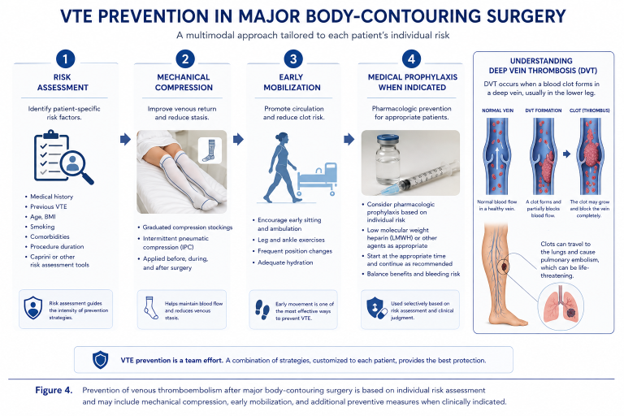
One of the important safety considerations in major body-contouring surgery is venous thromboembolism (VTE).
VTE includes deep vein thrombosis, in which a blood clot forms in a deep vein, and pulmonary embolism, in which part of a clot travels to the lungs.
The risk is influenced by multiple factors rather than by the name of the cosmetic procedure alone.
Patient-related factors, the extent and duration of surgery, postoperative mobility, previous history of thrombosis, and other clinical characteristics may all influence risk.
For this reason, VTE prevention should be based on individual risk assessment.
Depending on the patient’s risk profile and clinical plan, preventive measures may include mechanical compression during surgery, early postoperative mobilization, adequate hydration, and pharmacological prophylaxis when clinically indicated.
Patients should also receive clear postoperative instructions about mobility and warning symptoms requiring medical assessment.
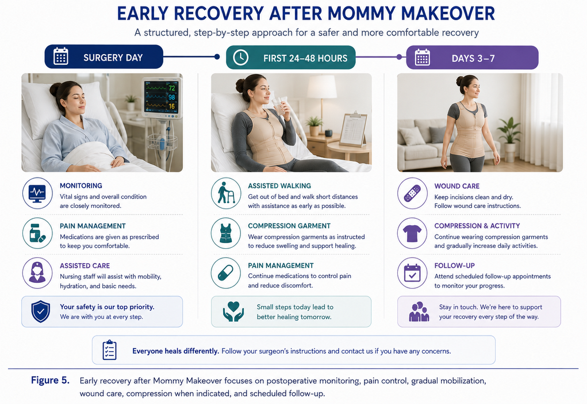
5. Early Recovery: The First 24–48 Hours
The first stage of recovery begins immediately after surgery.
Patients may experience swelling, tightness, bruising, fatigue, and postoperative discomfort. The degree varies according to the procedures performed.
Abdominoplasty can create a sensation of abdominal tightness, particularly when abdominal wall repair has been performed. Breast procedures may produce pressure or tightness across the chest, while liposuction can cause swelling and tenderness across the treated areas.
During this period, postoperative monitoring focuses on general condition, pain control, surgical wounds, circulation, mobility, and other procedure-specific considerations.
Early assisted walking is often an important part of postoperative care when clinically appropriate.
Patients undergoing abdominal surgery may initially walk in a slightly flexed posture because standing completely upright can place tension on the abdominal incision.
Depending on the procedures performed, compression garments, surgical bras, dressings, or drains may also be used.
The patient should receive clear instructions regarding medication, wound care, mobility, sleeping position, hydration, nutrition, and signs that require medical attention.
6. The First Week
During the first postoperative week, swelling and bruising are still expected.
Patients usually require substantial rest but should generally avoid remaining completely immobile unless specifically instructed for a medical reason.
Daily activity should increase gradually according to the procedure and the patient’s recovery.
Patients who have undergone abdominoplasty may continue to feel tightness when standing or walking. Breast swelling may temporarily make the breasts appear higher, firmer, or less symmetrical than their eventual position.
Similarly, areas treated with liposuction may appear irregular during early healing because of swelling and tissue edema.
These early appearances should not be interpreted as the final surgical result.
Follow-up during this period allows the surgical team to evaluate wound healing, swelling, dressings, drains when present, and the patient’s general recovery.
7. Weeks 2–6: Gradual Return to Daily Activities
Recovery becomes progressively easier over the following weeks, although the timeline differs depending on the combination of procedures performed.
Many patients gradually resume light daily activities as discomfort decreases and mobility improves.
However, returning to normal daily movement is different from returning to strenuous exercise.
Heavy lifting, intense abdominal exercise, vigorous upper-body training, and activities that place excessive tension on surgical wounds may need to remain restricted until healing is sufficiently advanced.
Patients who have undergone abdominal muscle repair require particular attention to activities that substantially increase abdominal wall tension.
Similarly, breast surgery patients may need to limit heavy upper-body activity during the early healing period.
The surgeon should determine when specific activities can safely be resumed based on wound healing, procedure type, and individual recovery rather than relying solely on a universal calendar.
8. Recovery Is Not the Same for Every Mommy Makeover
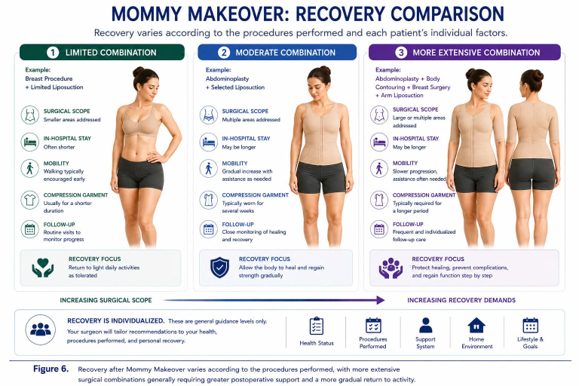
The term “Mommy Makeover recovery” can be misleading because there is no single recovery timeline applicable to every patient.
A patient undergoing breast augmentation and limited liposuction may recover differently from someone undergoing full abdominoplasty, rectus diastasis repair, extensive torso liposuction, and mastopexy.
The more extensive the surgical plan, the greater the potential impact on mobility, postoperative support requirements, wound care, and time needed before returning to strenuous activity.
For this reason, patients should receive a recovery plan based on their actual procedures, not simply a generic Mommy Makeover timeline.
One Response