

Mommy Makeover: Understanding Post-Pregnancy Body Changes
Pregnancy, childbirth, and breastfeeding can produce significant changes in a woman’s body. Although many of these changes gradually improve after delivery, others may remain despite exercise, healthy nutrition, and a stable body weight.
The abdomen may develop loose skin, localized fat deposits, reduced waist definition, or separation of the rectus abdominal muscles. At the same time, the breasts may lose volume, develop skin laxity, or descend to a lower position following pregnancy and breastfeeding.
A Mommy Makeover is not a single operation or a standardized package of cosmetic procedures. Instead, it describes an individualized surgical approach that may combine selected breast and body-contouring procedures according to the patient’s anatomy, degree of post-pregnancy change, general health, and aesthetic goals.
For some patients, the main concern is the abdomen. For others, breast changes are more significant. Many patients experience a combination of changes affecting the breasts, abdomen, waist, and flanks.
Understanding these anatomical changes is therefore the first step in determining whether surgery may be appropriate and which procedures should be considered.
1. What Is a Mommy Makeover?
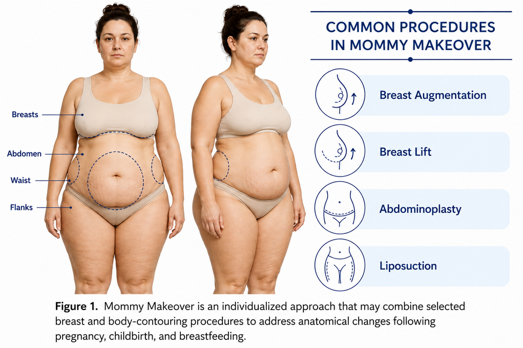
The term Mommy Makeover refers to a personalized combination of procedures designed to address physical changes that may remain after pregnancy and childbirth.
Despite its name, there is no single surgical procedure called a Mommy Makeover.
Depending on the patient’s anatomy, treatment may involve the breasts, abdomen, waist, flanks, or a combination of these areas. Procedures commonly considered include abdominoplasty, liposuction, breast lift, breast augmentation, and breast lift with augmentation.
This distinction is important because patients with apparently similar concerns may have very different underlying anatomical problems.
For example, abdominal fullness caused primarily by localized subcutaneous fat is different from an abdomen affected by significant excess skin and separation of the rectus muscles.
Similarly, loss of breast volume is different from breast ptosis, even though both conditions may occur after pregnancy and breastfeeding.
A comprehensive assessment should therefore identify whether the patient’s primary concerns are related to skin, fat, abdominal wall structure, breast volume, breast position, or a combination of these factors.
The objective is not to perform as many procedures as possible, but to determine which anatomical structures have changed and which procedures may appropriately address them.
2. How Pregnancy Can Change the Abdomen
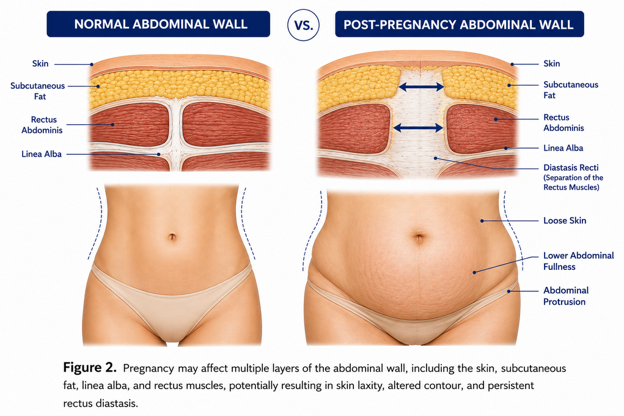
During pregnancy, the abdominal wall undergoes substantial expansion to accommodate the growing uterus.
The skin stretches, connective tissues are placed under increasing tension, and the paired rectus abdominis muscles may gradually separate along the midline.
After childbirth, some of these changes naturally improve. However, the degree of recovery varies considerably between individuals.
Some women retain good skin elasticity and abdominal wall support, while others may experience persistent loose abdominal skin, lower abdominal folds, stretch-related changes, altered fat distribution, or abdominal protrusion.
One particularly important structural change is diastasis recti, or separation of the rectus abdominal muscles.
The rectus muscles normally run vertically along the front of the abdomen. During pregnancy, the connective tissue between them can stretch and widen. When significant separation remains after pregnancy, the abdomen may continue to appear rounded or projected even in patients who are not significantly overweight.
This distinction has practical implications for treatment.
Liposuction can reduce subcutaneous fat, but it does not repair rectus diastasis or remove substantial excess skin.
Exercise can strengthen the abdominal muscles, but it may not completely reverse significant structural separation or restore skin that has lost substantial elasticity.
For this reason, understanding whether abdominal fullness originates from fat, excess skin, abdominal wall laxity, or several factors together is essential before choosing a treatment.
3. Changes in the Waist, Flanks and Body Contour
Post-pregnancy body changes are not limited to the central abdomen.
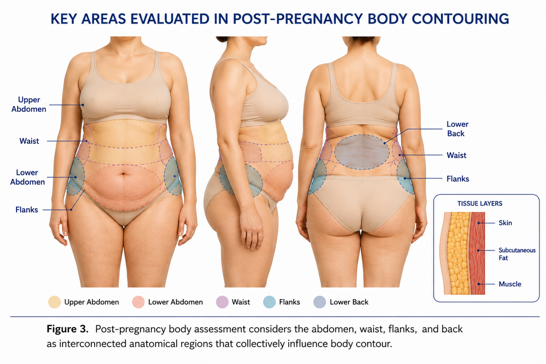
Localized subcutaneous fat may remain around the lower abdomen, waist, flanks, hips, or lower back, even after body weight has stabilized.
These areas contribute collectively to the overall silhouette.
For example, treating the central abdomen without considering fullness around the flanks may improve abdominal projection without substantially restoring waist definition.
This is why body contouring should evaluate the relationship between anatomical regions rather than viewing every localized fat deposit as an isolated problem.
Skin quality is equally important.
A patient with localized fat and good skin elasticity may require a very different approach from someone with a similar amount of fat but significant skin laxity.
Therefore, the evaluation of post-pregnancy body contour should consider fat distribution, skin elasticity, abdominal wall structure, and the relationship between the abdomen, waist, flanks, and back.
4. How Pregnancy and Breastfeeding Can Change the Breasts
The breasts also undergo considerable physiological changes during pregnancy and breastfeeding.
Breast volume commonly increases during pregnancy. Following childbirth and breastfeeding, subsequent reduction in glandular volume may leave the skin envelope relatively loose.
However, the resulting breast appearance differs considerably between patients.
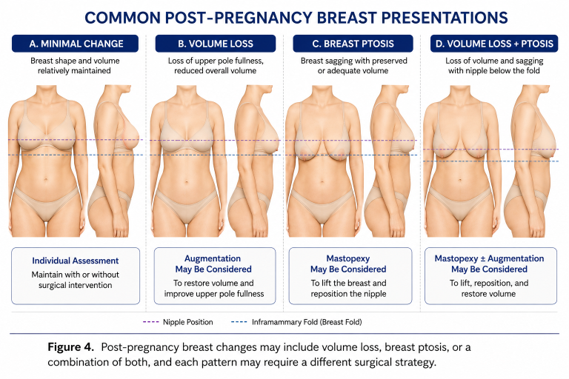
Some women primarily experience loss of breast volume, particularly upper-pole fullness.
Others maintain adequate breast volume but develop breast ptosis, in which the breast tissue and nipple–areola complex descend relative to the inframammary fold.
A third group may experience both volume loss and ptosis.
Distinguishing between these conditions is important because they may require different surgical approaches.
Patients with volume loss and minimal ptosis may potentially be considered for breast augmentation, whereas patients with adequate volume but significant ptosis may be better suited to mastopexy (breast lift).
When both volume loss and significant ptosis are present, a breast lift combined with augmentation may be considered in selected patients.
Therefore, breast treatment within a Mommy Makeover does not automatically mean breast implants.
Breast volume, skin quality, nipple–areola position, breast width, degree of ptosis, existing asymmetry, and desired proportions should all be considered before a procedure is selected.
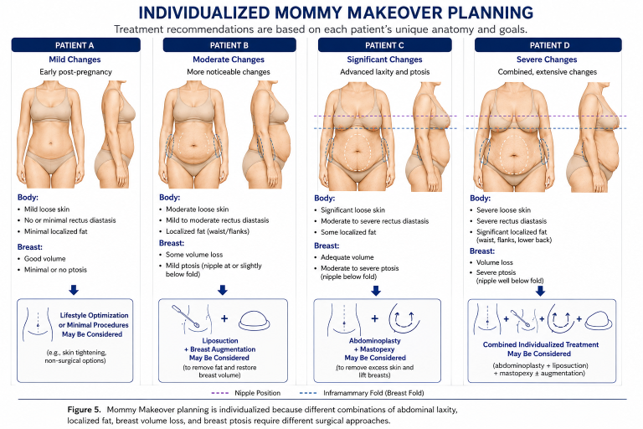
5. Why Mommy Makeover Is Different for Every Patient
One of the most important principles of Mommy Makeover surgery is that there is no universal combination of procedures appropriate for every patient.
Consider several examples.
A patient with significant abdominal skin laxity and rectus diastasis but relatively unchanged breasts may primarily require abdominal treatment.
Another patient may have good abdominal skin but localized waist fat and substantial breast volume loss.
A third may have abdominal laxity together with breast ptosis but still retain sufficient natural breast volume, meaning that breast implants may not necessarily be required.
A more complex patient may present with abdominal skin excess, rectus diastasis, localized fat, breast volume loss, and ptosis simultaneously.
These patients should not automatically receive the same surgical package.
The appropriate plan should identify the patient’s most important anatomical concerns, determine which procedures can address them, and consider whether the proposed combination represents an appropriate surgical burden.
In some patients, several procedures may be combined. In others, a more limited operation or staged surgical approach may be preferable.
6. Who May Be a Candidate?
Mommy Makeover may be considered for patients with persistent post-pregnancy changes who are medically appropriate candidates for elective surgery.
Several factors are important when evaluating candidacy.
A relatively stable body weight is generally desirable because substantial weight changes after surgery can alter both abdominal and breast contours.
Future pregnancy plans should also be discussed. Surgery does not necessarily prevent a future pregnancy, but another pregnancy may stretch the abdominal wall and breast tissues again and alter the surgical result.
For this reason, many patients choose to consider Mommy Makeover after completing their planned pregnancies.
General health is particularly important when multiple procedures are being considered.
Medical history, previous operations, medications, nicotine exposure, bleeding or thrombotic history, and other factors that may influence surgical or anesthetic risk should be reviewed.
Previous abdominal scars—including a Cesarean-section scar—should also be assessed when planning abdominal surgery.
Finally, expectations should remain realistic. Mommy Makeover may substantially improve body contour, but surgery cannot recreate the exact body that existed before pregnancy or prevent future changes caused by aging, gravity, weight fluctuation, or another pregnancy.
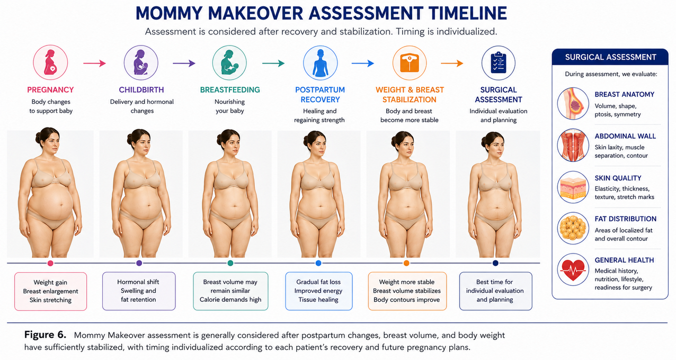
7. When Should Mommy Makeover Be Considered?
The body continues to change for some time following childbirth.
Abdominal tissues recover, body weight may fluctuate, and breast size and shape may continue changing during and after breastfeeding.
For this reason, surgical assessment is generally more meaningful once postpartum changes have sufficiently stabilized.
Rather than applying one universal waiting period, timing should be individualized according to factors including:
completion of breastfeeding, stabilization of breast volume, stable body weight, recovery from pregnancy and childbirth, overall health, and future pregnancy plans.
The objective is to evaluate the patient’s anatomy after temporary postpartum changes have largely settled so that persistent structural changes can be identified more accurately.
8. From Anatomy to an Individualized Treatment Plan
A Mommy Makeover consultation should therefore begin with anatomical assessment rather than with the selection of a predetermined package.
For the abdomen, evaluation may include skin elasticity, excess skin, subcutaneous fat, previous scars, abdominal wall laxity, and rectus diastasis.
For the torso, the distribution of fat around the abdomen, waist, flanks, hips, and back may be considered together.
Breast assessment may evaluate breast volume, skin quality, nipple–areola position, degree of ptosis, breast width, inframammary folds, chest-wall anatomy, and existing asymmetry.
These findings can then be combined to establish priorities.
The central question is not simply:
“Which procedures can be performed?”
Instead, it is:
“Which anatomical problems need to be corrected, and which combination of procedures can address them appropriately?”
This individualized approach forms the foundation of Mommy Makeover planning.

Conclusion
Mommy Makeover is best understood not as a fixed package of cosmetic procedures, but as an individualized approach to post-pregnancy body contouring.
Pregnancy and breastfeeding can affect several anatomical structures simultaneously. The abdomen may develop excess skin, localized fat, reduced waist definition, or rectus diastasis, while the breasts may experience volume loss, ptosis, or both.
Because the pattern and severity of these changes differ considerably between patients, appropriate surgical planning begins with identifying the underlying anatomy.
Only after this assessment should procedures such as abdominoplasty, liposuction, breast lift, breast augmentation, or selected combinations of these procedures be considered.
The next step is understanding what each procedure can—and cannot—correct, and how different procedures may be combined according to the patient’s anatomy and treatment priorities.
→ Next Article: Mommy Makeover Procedures — Choosing the Right Combination