

A-Understanding Facial Volume Loss and Fat Grafting
Facial aging is not caused by skin laxity and wrinkles alone. Changes in facial volume and the position of soft tissues also contribute to an older appearance.
Over time, the temples may become hollow, cheek projection may decrease, and the transition between the lower eyelid and cheek may become more pronounced. These changes can alter facial proportions even when skin laxity is relatively limited.
Facial fat grafting, also known as autologous fat transfer, uses a patient’s own fat to restore volume in selected facial areas. Fat is harvested from another part of the body, prepared, and carefully transferred to areas where additional volume may improve facial contour.
The objective is not simply to make the face fuller. Treatment should aim to restore appropriate volume while preserving natural facial proportions.
1. What Is Facial Fat Grafting?
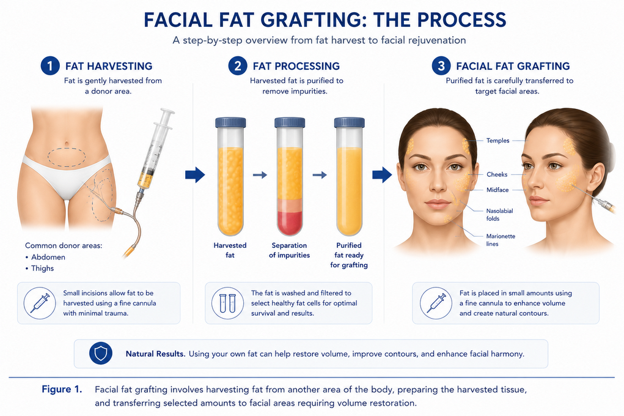
Facial fat grafting is a surgical technique that transfers autologous fat from one area of the patient’s body to selected areas of the face.
The procedure generally consists of three stages:
Fat Harvesting → Fat Processing → Fat Placement
Fat is commonly obtained from areas such as the abdomen, waist, flanks, or thighs. After appropriate preparation, small amounts are transferred into selected facial regions.
Because the transferred tissue comes from the patient’s own body, no synthetic volumizing material is required.
However, facial fat grafting should not be approached as simply filling every visible hollow.
The face is a three-dimensional structure. The relationship between the forehead, temples, cheeks, midface, eyelid–cheek junction, and lower face determines overall facial balance.
For this reason, treatment planning should consider facial proportions as a whole rather than individual depressions in isolation.
2. Why Does Facial Volume Change With Age?
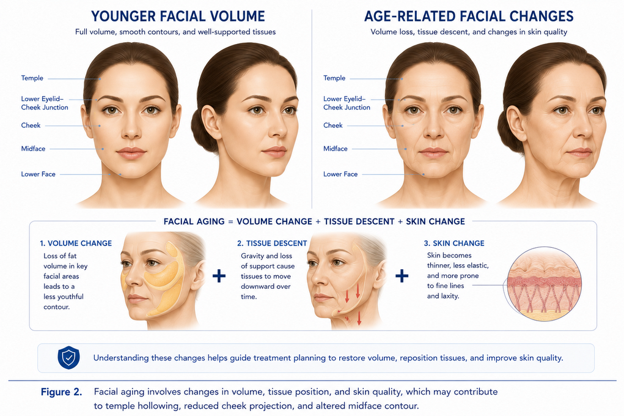
Facial aging involves changes at several anatomical levels.
Skin becomes less elastic, supporting tissues may descend, facial fat compartments change in volume and position, and underlying skeletal changes may also influence facial contour.
Common manifestations include:
- Hollowing of the temples
- Reduced cheek projection
- Flattening of the midface
- A more visible lower eyelid–cheek junction
- Deeper facial shadows and folds
- Changes in overall facial contour
An important distinction is that volume loss and tissue descent are not the same problem.
For example, a hollow temple or deficient cheek may benefit from volume restoration. In contrast, prominent jowls or significant lower-face laxity are more strongly associated with tissue descent and may require a different treatment strategy.
Some patients have predominantly volume deficiency, while others have both volume loss and tissue laxity.
Recognizing this difference helps determine whether fat grafting alone is appropriate or whether other facial rejuvenation procedures should also be considered.
3. Which Areas Can Be Treated?
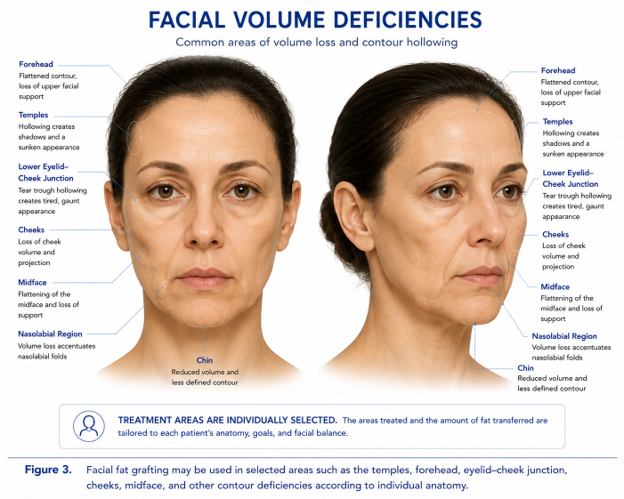
Fat grafting may be considered for several facial areas depending on individual anatomy.
Temples: Volume loss can create a hollow transition between the forehead and cheekbone.
Forehead: Selected volume deficiencies may affect forehead contour and upper-face proportions.
Lower eyelid–cheek junction: Loss of volume can contribute to a hollow or tired appearance. This region requires careful assessment because not every under-eye concern is caused by volume deficiency.
Cheeks and midface: Restoring selected volume may improve cheek projection and the transition between the eyelids, cheeks, and lower face.
Nasolabial and perioral areas: Fat may be considered as part of broader facial volume restoration rather than simply filling an isolated fold.
Chin and other contour deficiencies: Selected patients may benefit from conservative fat placement to improve facial transitions and proportions.
Not every patient requires treatment in all of these areas. The location and amount of fat should be determined according to individual facial anatomy.
4. Who May Be a Candidate for Facial Fat Grafting?
Facial fat grafting may be considered in medically appropriate patients with identifiable volume deficiency.
Potential indications include naturally hollow temples, reduced cheek or midface volume, age-related volume loss, selected under-eye–cheek deficiencies, contour irregularities, and certain forms of facial asymmetry.
Age alone does not determine candidacy.
A younger patient may have naturally limited facial volume without significant skin laxity. An older patient may have both volume deficiency and tissue descent.
This distinction is important because adding volume cannot necessarily replace lifting procedures when significant sagging is present.
Attempting to compensate for substantial tissue descent by adding excessive volume may produce a heavier appearance rather than restoring youthful proportions.
Appropriate assessment should therefore determine whether the primary concern is:
Volume Loss • Tissue Descent • Skin Laxity • or a Combination
This anatomical assessment forms the basis for deciding whether facial fat grafting should be performed alone or incorporated into a broader facial rejuvenation plan.
Restoring Facial Volume With Autologous Fat
B -Technique, Facial Proportions and Combination With Facelift
5. Where Is the Fat Harvested From?
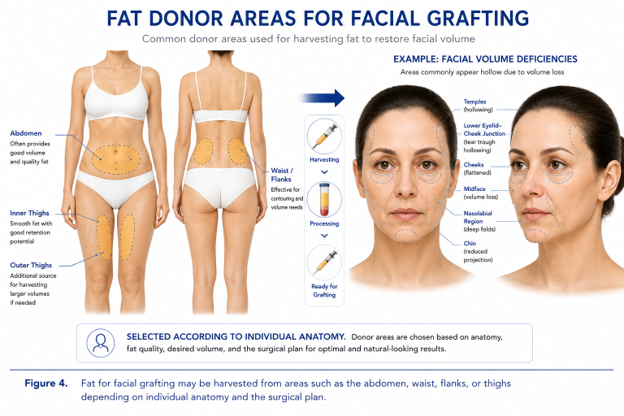
Facial fat grafting begins by harvesting a relatively small amount of fat from another area of the patient’s body.
Common donor areas include the abdomen, waist, flanks, and thighs. The donor site is selected according to the patient’s anatomy, available fat, previous procedures, and overall surgical plan.
Because facial fat grafting generally requires much less fat than breast or buttock fat transfer, extensive liposuction is not necessarily required simply to obtain the graft.
When facial fat grafting is combined with body liposuction or another contouring procedure, suitable fat may be harvested during the same operation.
Careful harvesting and tissue handling are important because the quality of the transferred tissue depends partly on how the fat is collected and prepared.
6. How Is the Fat Prepared?
After harvesting, the fat is prepared before being transferred to the face.
The purpose of processing is to obtain suitable graft material while reducing unwanted components such as excess fluid, oil, or blood.
Different processing techniques may be used, but the general sequence can be summarized as:
Harvesting → Processing → Preparation → Reinjection
The prepared fat is then transferred into smaller syringes or appropriate delivery systems so that it can be placed precisely into selected facial areas.
No single step determines the final result.
Fat retention is influenced by several factors, including tissue handling, recipient-site characteristics, blood supply, injection technique, smoking or nicotine exposure, and individual healing.
For this reason, it is difficult to apply one universal percentage of fat survival to every patient.
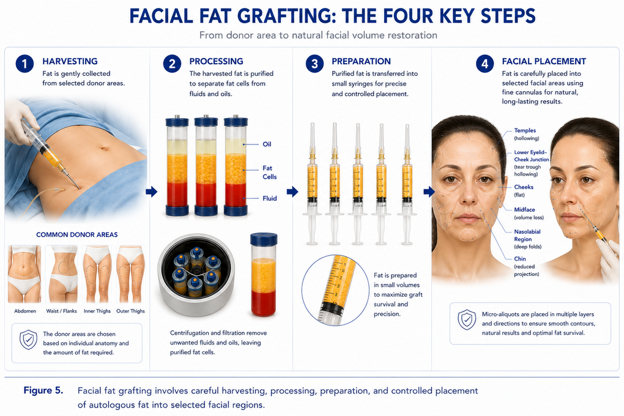
7. How Is Fat Placed Into the Face?
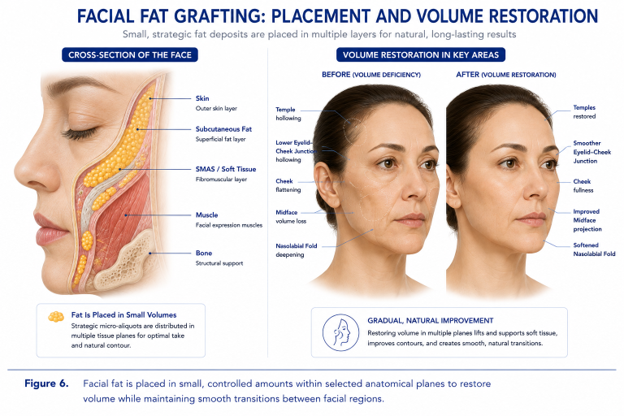
Facial fat grafting requires an understanding of the different anatomical layers of the face.
Rather than placing a large amount of fat in one location, fat is generally distributed in small, controlled amounts within selected tissue planes according to the anatomy and objective of each region.
The appropriate technique differs between the temples, forehead, cheeks, midface, lower eyelid–cheek junction, and lower face.
The aim is to create smooth transitions between adjacent regions while avoiding excessive or localized fullness.
This is particularly important in areas such as the lower eyelid–cheek junction, where the tissues are relatively delicate and small changes in contour may be noticeable.
Treatment therefore requires more than deciding how many milliliters of fat should be added. The surgeon must also consider where the volume is needed, at what anatomical level, and how that volume will influence surrounding facial proportions.
8. Restoring Proportion Rather Than Simply Adding Volume
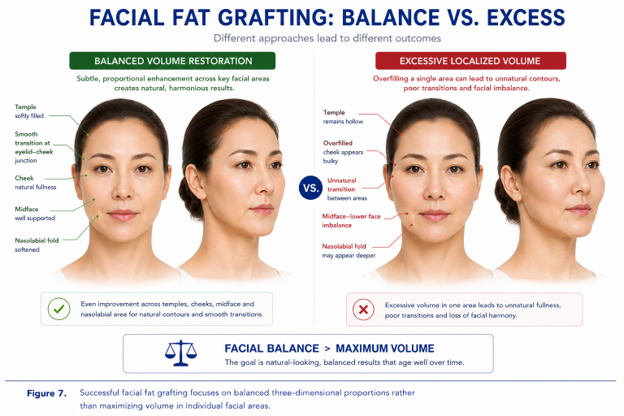
An important principle of facial fat grafting is that more volume does not necessarily mean a better result.
Facial appearance depends on the relationship between multiple regions.
The forehead and temples influence upper-face contour, cheek projection shapes the midface, and the relationship between the lower eyelid and cheek influences whether the central face appears smooth or hollow.
These regions should therefore not be assessed independently.
For example, concentrating a large amount of fat directly into a visible depression may make that area fuller without improving the overall balance of the face.
In selected patients, smaller amounts distributed across several connected areas may produce a more harmonious three-dimensional contour.
This is also why facial fat grafting should not aim to recreate the generalized fullness of a much younger face. The objective is to restore appropriate volume for the patient’s individual anatomy, not to eliminate every natural shadow or contour.
9. Facial Fat Grafting and Facelift Surgery
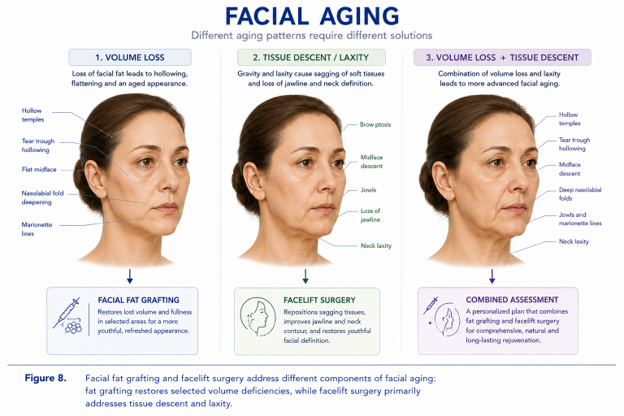
Volume loss is only one component of facial aging.
With increasing age, facial tissues may also descend, contributing to changes such as jowls, loss of jawline definition, midface descent, and neck laxity.
This creates an important distinction between volume restoration and tissue repositioning.
Facial fat grafting primarily restores selected areas of volume deficiency.
Facelift surgery primarily addresses descended or lax tissues by repositioning and supporting facial structures according to the surgical technique used.
For a patient whose main concern is hollow temples or reduced cheek volume without significant laxity, fat grafting alone may be considered.
For another patient with substantial jowling and lower-face laxity, simply adding more volume may not correct the underlying problem.
Many older patients have both conditions simultaneously: volume loss + tissue descent.
In selected cases, fat grafting can therefore complement facelift surgery. The facelift addresses tissue position, while fat grafting restores volume where appropriate.
The objective is not to perform more procedures, but to treat the anatomical components actually responsible for the patient’s facial aging.
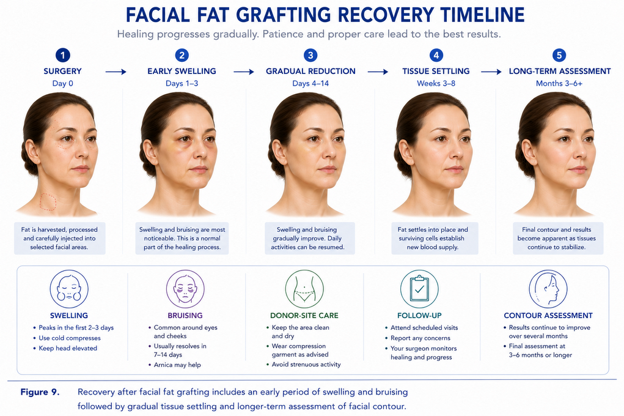
10. Recovery After Facial Fat Grafting
Recovery after facial fat grafting varies according to the number of facial regions treated, the amount of fat transferred, the donor area, and whether fat grafting is performed alone or combined with another procedure.
During the early postoperative period, swelling is expected and may make the treated areas appear fuller than the eventual result. Bruising can also occur, particularly around thinner areas such as the lower eyelid–cheek junction.
The donor area may feel sore or tender for several days. Depending on the location and amount of fat harvested, compression garments may be recommended.
As swelling gradually decreases, facial contour becomes easier to evaluate.
11. Why Does Facial Volume Change During Recovery?
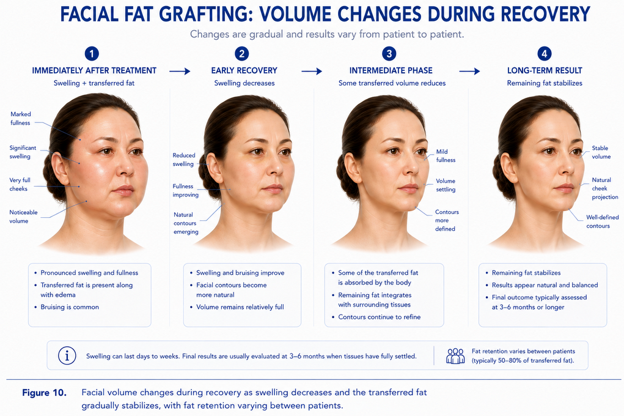
Immediately after surgery, the face may appear relatively full because of both postoperative swelling and the transferred fat.
As swelling resolves, some of this early fullness decreases.
In addition, not all transferred fat necessarily persists long term. A portion of the graft may not survive, while the remaining fat gradually integrates into the surrounding tissues.
This means that the appearance during the first days or weeks should not be considered the final result.
Fat retention varies between patients and between different facial regions. It may also be influenced by recipient-site blood supply, tissue handling, injection technique, smoking or nicotine exposure, and individual healing characteristics.
For this reason, it is more accurate to discuss variable fat retention rather than promise a fixed survival percentage for every patient.
12. How Long Can the Result Last?
Once transferred fat has successfully integrated with the surrounding tissues, the remaining fat may provide long-lasting volume restoration.
However, the result should not be considered permanently unchanged.
The face continues to age, supporting tissues continue to change, and facial fat distribution may evolve over time.
Significant weight gain may increase the volume of fat cells, while substantial weight loss may reduce facial fullness.
Therefore, long-term results are influenced by the patient’s anatomy, aging process, tissue quality, lifestyle, and weight stability.
The realistic objective is durable improvement in selected areas while preserving natural facial proportions.
13. Potential Risks and Limitations
Like other surgical procedures, facial fat grafting has potential risks and limitations.
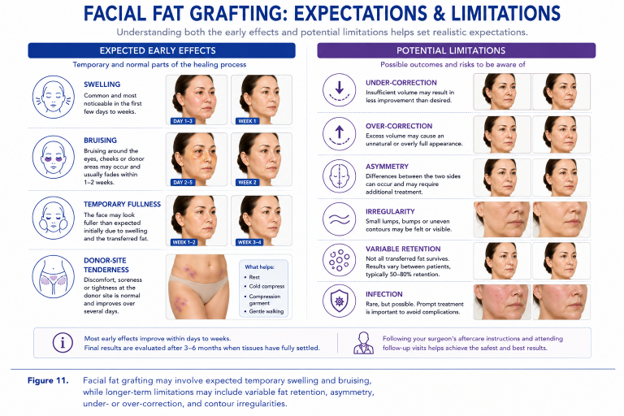
Temporary effects may include:
- Swelling
- Bruising
- Donor-site tenderness
- Temporary asymmetry during early healing
Other possible issues include:
- Under-correction
- Over-correction
- Irregular contour
- Variable fat retention
- Asymmetry
- Infection
- Need for additional treatment in selected patients
Because the final amount of retained fat cannot be predicted with absolute precision, some patients may require reassessment after the tissues have stabilized.
A conservative, anatomy-based approach is therefore important when planning treatment.
14. Can Facial Fat Grafting Be Repeated?
Yes. Additional fat grafting may be considered after the initial result has stabilized.
This does not necessarily mean that the first procedure was unsuccessful.
Because fat retention varies, some patients may achieve the desired improvement after one treatment, while others may benefit from additional refinement.
In selected patients, a staged approach with conservative volume placement may be preferable to attempting excessive correction during a single procedure.
The decision to repeat treatment should be based on remaining volume deficiency, facial proportions, previous response to fat grafting, and the presence of other signs of facial aging.
15. Frequently Asked Questions
Is facial fat grafting permanent?
Some transferred fat may persist long term after it integrates with surrounding tissues, but the face continues to change with aging, tissue remodeling, and weight fluctuation.
How much of the transferred fat survives?
There is no universal survival percentage. Fat retention varies between patients, facial regions, and individual healing conditions.
Will my face look too full?
The face may appear fuller during early recovery because of swelling. Appropriate treatment aims for balanced volume restoration rather than excessive fullness.
Can facial fat grafting improve under-eye hollows?
It may be considered in selected patients with true volume deficiency in the lower eyelid–cheek region. Not all under-eye concerns are caused by volume loss.
Can fat grafting be combined with facelift surgery?
Yes. Fat grafting restores selected volume deficiencies, while facelift surgery addresses tissue descent and laxity. The two procedures may complement each other in appropriately selected patients.
Can facial fat grafting be repeated?
Yes. Additional treatment may be considered after the initial result has stabilized.
Conclusion
Facial fat grafting is not simply a technique for making the face fuller.
A successful treatment plan begins with identifying where volume has been lost, how that loss affects overall facial proportions, and whether volume deficiency exists alone or together with tissue descent and skin laxity.
Fat grafting can restore selected facial volume using the patient’s own tissue and may be particularly useful in the temples, cheeks, midface, and other carefully selected areas.
However, natural-looking results depend on appropriate anatomical assessment, conservative volume placement, careful technique, and realistic expectations regarding fat retention.
In some patients, facial fat grafting may be performed alone. In others, it may be combined with facelift surgery as part of a broader facial rejuvenation plan.