

A Mommy Makeover is not defined by the number of procedures performed, but by how well the selected procedures address the patient’s actual anatomical changes.
After pregnancy and breastfeeding, some patients primarily develop excess abdominal skin and rectus diastasis. Others retain localized fat around the waist and flanks. Some experience breast volume loss, breast ptosis, or both. Because these changes vary considerably, the surgical plan should be built around anatomy rather than a fixed “package.”
The most commonly considered procedures are abdominoplasty, liposuction, breast lift, breast augmentation, and combined breast lift with augmentation. The key is determining which procedure treats which problem—and when several procedures may appropriately complement one another.
1. Abdominoplasty: Treating Excess Skin and Abdominal Wall Laxity
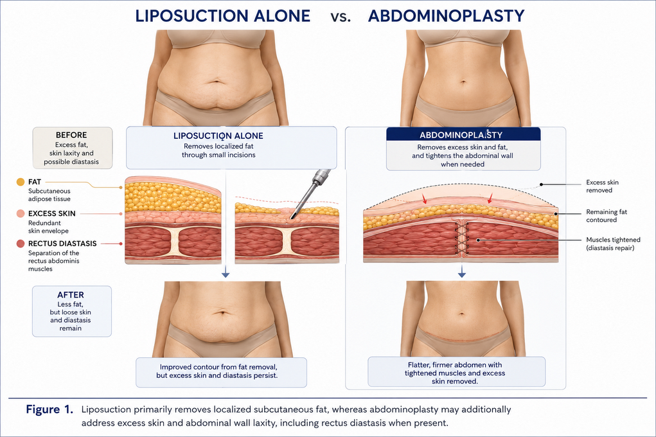
Abdominoplasty, commonly known as a tummy tuck, is designed to address structural changes that liposuction alone cannot correct.
The procedure may involve removal of excess abdominal skin, tightening of the abdominal wall when rectus diastasis is present, reshaping of the lower abdomen, and repositioning of the umbilicus when required.
Patients with significant loose skin after pregnancy often notice that diet and exercise can reduce body fat but cannot remove redundant skin. Likewise, patients with persistent rectus diastasis may continue to have a rounded or projected abdomen even after returning to a stable weight.
In these situations, abdominoplasty can address several anatomical layers at the same time.
It is important to distinguish between Mini Abdominoplasty and Full Abdominoplasty. Mini abdominoplasty may be appropriate when the main problem is limited to the lower abdomen, whereas full abdominoplasty is more commonly considered when excess skin and abdominal wall laxity involve a larger area.
The final choice depends on the distribution of loose skin, abdominal wall anatomy, previous scars, umbilical position, and the overall treatment plan.
2. Liposuction and 360° Body Contouring
Liposuction is frequently considered within a Mommy Makeover because pregnancy-related body changes often extend beyond the central abdomen.
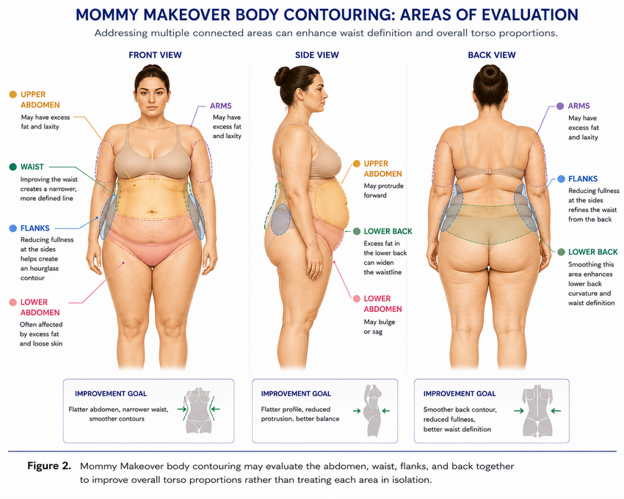
Localized fat may persist around the waist, flanks, hips, lower back, or upper abdomen even after body weight has stabilized.
The purpose of liposuction is not simply to remove the greatest possible amount of fat. Instead, the objective is to improve body proportions by reducing selected fat deposits while preserving smooth transitions between adjacent regions.
This is particularly important in the torso.
Treating only the front of the abdomen may leave persistent fullness at the flanks and back, limiting waist definition. For selected patients, a broader body-contouring approach may therefore evaluate the abdomen, waist, flanks, and back together.
This concept is sometimes described as 360° body contouring.
However, the extent of liposuction should always be individualized according to the patient’s anatomy, skin quality, surgical plan, and safety considerations.
Liposuction also does not replace abdominoplasty when substantial loose skin or rectus diastasis is present. In many cases, the two procedures serve complementary purposes rather than competing with one another.
3. Breast Lift: Correcting Breast Ptosis
Pregnancy and breastfeeding can stretch the breast skin envelope and alter the position of the breast tissue and nipple–areola complex.
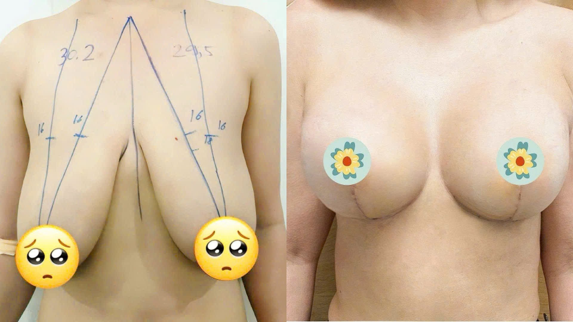
When sufficient breast volume remains but the breast has descended, mastopexy (breast lift) may be considered.
The objective of mastopexy is not necessarily to increase breast size. Instead, the procedure may remove excess skin, reshape the existing breast tissue, elevate the nipple–areola complex, and restore a firmer breast contour.
The incision pattern depends on the degree of ptosis, amount of excess skin, breast volume, and the amount of reshaping required.
Patients with mild ptosis may require a more limited skin-removal pattern, while patients with significant post-pregnancy skin laxity may need a vertical or inverted-T pattern.
The important point is that a breast lift treats breast position and skin excess, not simply breast volume.
Breast Augmentation: Restoring Lost Volume
Some patients maintain a relatively good breast position after pregnancy but experience significant loss of breast volume, particularly in the upper breast.
In these cases, breast augmentation may be considered to restore volume and improve breast proportions.
Implant selection should not be based solely on a desired number of cubic centimeters.
The surgeon should evaluate:
- Breast base width
- Chest dimensions
- Soft-tissue thickness
- Skin elasticity
- Existing breast volume
- Desired projection
- Overall body proportions
The objective is to choose an implant that complements the patient’s anatomy rather than simply creating the largest possible breast size.
In appropriately selected patients with minimal ptosis, augmentation alone may restore fullness without the need for breast lifting.
However, placing an implant into a significantly ptotic breast does not reliably correct excess skin or a low nipple position. This is why assessment of breast position is as important as assessment of volume.
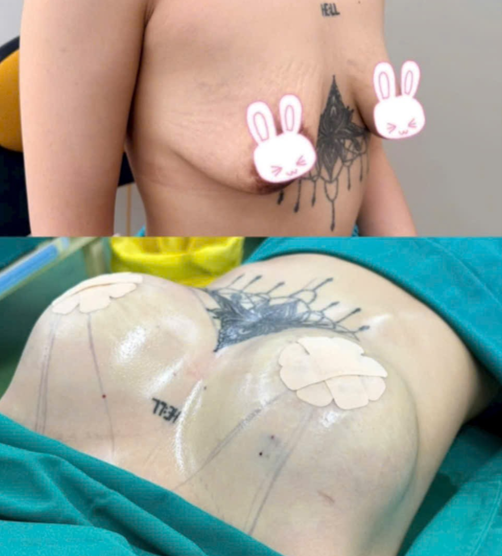
5. Breast Lift With Implants: When Both Position and Volume Need Correction
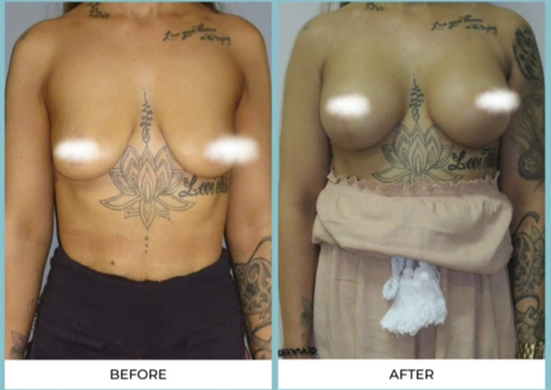
A common post-pregnancy pattern involves both loss of breast volume and significant ptosis.
In these patients, a breast lift alone may improve position but may not restore the desired upper-pole fullness. Conversely, an implant alone may increase volume without adequately correcting the stretched skin envelope or low nipple position.
A combined augmentation-mastopexy may therefore be considered.
The breast lift addresses excess skin and tissue position, while the implant restores selected volume and projection.
This combination requires careful planning because both the breast envelope and implant pocket are being modified during the same operation.
Implant size should be selected conservatively according to soft-tissue support and breast anatomy. Excessively large implants may place additional tension on newly reshaped breast tissues and scars.
6. Choosing the Right Combination
The central question in Mommy Makeover surgery is not “Which procedures are available?” but rather “Which combination is appropriate for this patient?”
Several common patterns illustrate this.
Pattern A — Abdominal Skin Laxity + Rectus Diastasis
If the main concerns are loose abdominal skin and abdominal wall separation, abdominoplasty may be the primary procedure.
Liposuction may be added selectively if localized fat around the waist or flanks affects overall contour.
Pattern B — Localized Torso Fat + Stable Abdominal Skin
If the abdominal skin remains relatively elastic and the primary concern is localized fat, liposuction/body contouring may be sufficient without abdominoplasty.
Pattern C — Abdominal Laxity + Breast Ptosis
A patient with significant abdominal skin excess and breast ptosis but adequate breast volume may potentially be treated with abdominoplasty + mastopexy.
Breast implants are not automatically required.
Pattern D — Abdominal Laxity + Breast Volume Loss
If the patient has abdominal wall concerns and breast volume loss without major ptosis, abdominoplasty + breast augmentation may be considered.
Pattern E — Abdominal Laxity + Localized Fat + Breast Ptosis and Volume Loss
A more complex pattern may involve abdominoplasty + liposuction + mastopexy ± augmentation.
However, complexity alone does not mean all procedures should necessarily be performed at the same time.
The overall surgical burden, expected operative duration, patient’s health, risk factors, and recovery requirements should also be considered.
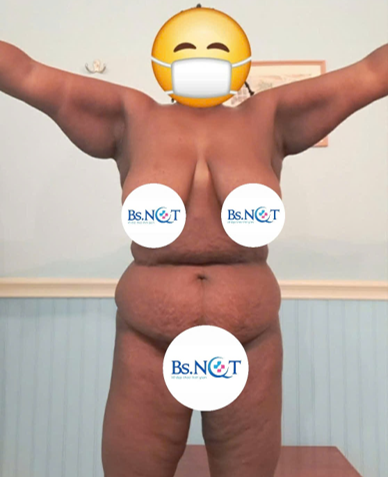
7. Can All Procedures Be Performed at the Same Time?
One of the most common questions about Mommy Makeover surgery is whether all desired procedures should be completed during one operation.
There is no universal answer.
Combining procedures may reduce the number of separate anesthetic events and consolidate recovery into one period. However, combining multiple major operations also increases operative complexity and may lengthen surgical time.
The decision should therefore consider:
- Overall health
- Number and extent of procedures
- Expected operative duration
- Blood-loss considerations
- Venous thromboembolism risk
- Previous surgery
- Smoking or nicotine exposure
- Body mass index and comorbidities
- Postoperative support and recovery environment
In some patients, combining procedures may be reasonable. In others, a staged approach may offer a more appropriate balance between surgical goals and safety.
The objective should never be to maximize the number of procedures performed during one operation.
The objective is to develop a treatment plan that appropriately balances anatomical correction, surgical efficiency, patient safety, and recovery demands.

8. Why More Is Not Always Better
Mommy Makeover should not be viewed as an opportunity to address every perceived imperfection during one operation.
A successful treatment plan prioritizes the procedures that provide the greatest anatomical benefit while avoiding unnecessary surgical intervention.
For example, a patient with adequate breast volume does not necessarily benefit from an implant simply because breast augmentation is commonly associated with Mommy Makeover.
Likewise, a patient with good abdominal skin elasticity may not require abdominoplasty merely because it is another frequently performed component.
The most appropriate strategy is often the least extensive combination that adequately corrects the patient’s primary anatomical concerns.
This approach can reduce unnecessary procedures, simplify recovery, and help maintain more natural body proportions.
Conclusion
Mommy Makeover procedures should be selected according to anatomy rather than according to a fixed surgical package.
Abdominoplasty addresses excess abdominal skin and abdominal wall laxity. Liposuction reduces selected subcutaneous fat deposits and can improve torso proportions. Mastopexy addresses breast ptosis, while breast augmentation restores lost volume. When both position and volume have changed, a combined breast lift and augmentation may be considered.
The correct combination varies from patient to patient.
The most important question is not how many procedures can be performed, but which procedures are necessary, how they complement one another, and whether the overall plan is appropriate for the patient’s health and recovery profile.
→ Next Article: Mommy Makeover Safety, Recovery, Scars & Long-Term Results
One Response